
What Is a C-Arm? Understanding This Important Imaging Tool Used During Surgery
Written by Sukanya Chebrolu, MS and Chukwunonso C. Ilogu, MD, MS of the LESS™ Society
When preparing for surgery or a pain management procedure, you may hear your care team mention using a C-arm. This device plays a crucial role in today’s modern surgical care. It is an advanced X-ray imaging machine shaped like the letter “C.” One end holds the X-ray source and the other holds a detector, allowing the machine to move freely around the patient and capture high-quality images from multiple angles. Because of this mobility, this is widely used in spine surgery, orthopedic procedures, trauma surgeries, and pain injections, where accuracy and real-time visualization are essential (1).
The system delivers live imaging through fluoroscopy, displaying instant views of bones, joints, implants, and surgical instruments on a monitor in the operating room. This continuous visualization improves procedural accuracy and helps reduce errors, particularly in spine and orthopedic surgeries. Image guidance also supports smaller incisions and less invasive techniques, which can lead to reduced tissue trauma, lower blood loss, and faster recovery. Precise visualization of implant placement has been shown to decrease the likelihood of needing revision surgery later on. (2).
The C-arm functions using fluoroscopy, a technology that produces continuous, real-time imaging rather than a single static X-ray picture. This live video allows physicians to watch instruments move inside the body and make immediate adjustments. Fluoroscopy enables the precise placement of needles, implants, and screws during spine and orthopedic procedures.
During a procedure, patients generally do not feel or notice the imaging equipment being used, especially when under anesthesia. The device does not touch the body; it simply moves around the operating table and is positioned by a trained technologist or a member of the surgical team. For procedures performed with local anaesthesia (e.g., specific pain injections), you may be awake and aware of the machine, but the imaging remains quick, painless, and completely non-invasive.

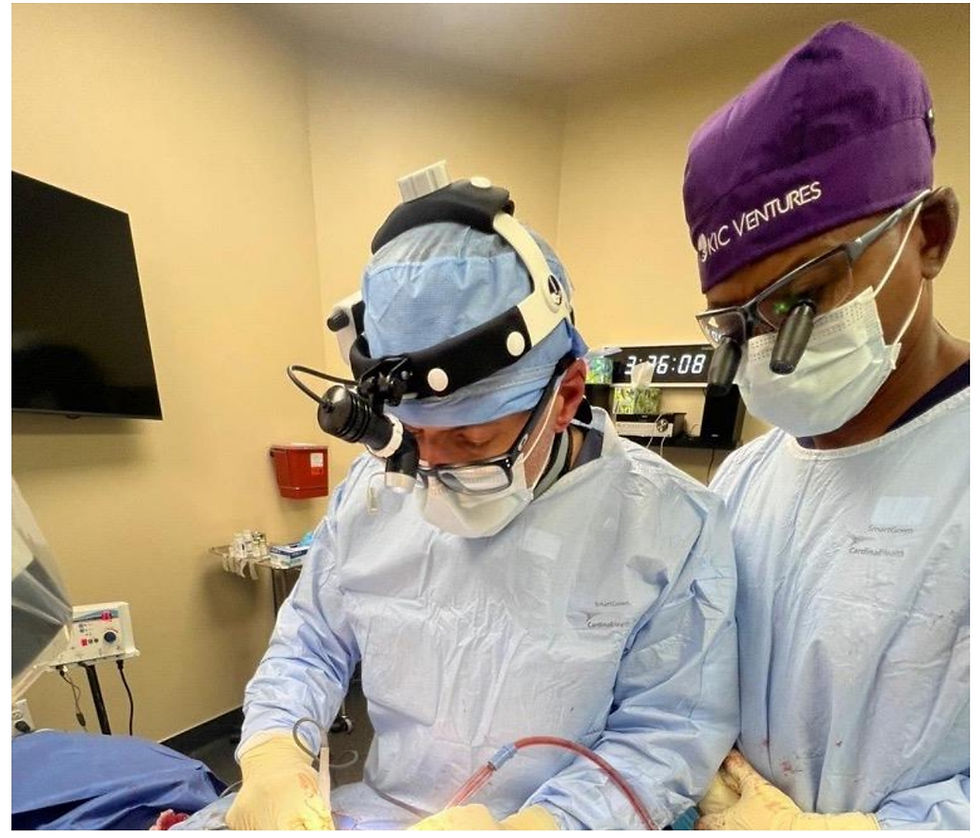
Image 1: C-arm fluoroscopy positioned beside the operating table, providing real-time imaging to guide the physician during a procedure.
Image source: https://www.kicventures.com/vet-tours?pgid=m7jw3g6p-ad0e0e02-bbde-4457-b438-7831ceb7dabe
How Is the Scan Performed? Does It Hurt?
Imaging is similar to a live X-ray, and the process is:
Painless — there is no sensation during imaging.
Quick — images are captured within seconds.
Non-invasive — nothing enters the body.
Safe — radiation exposure is kept to the minimum required.
If you are awake, the technologist may ask you to hold still briefly to obtain a clear image. During surgeries, the clinical team manages the entire process while you remain comfortably positioned.
How Patients Can Prepare for the Imaging Procedure
Most of the preparation is managed by your hospital or clinical team, but the following steps can help ensure smooth and accurate imaging:
Remove metal items: Jewellery, belts, and other metal accessories can interfere with image quality and should be removed before the procedure.
Wear comfortable clothing or a hospital gown: Loose clothing is recommended for outpatient procedures. For surgeries, the hospital will provide an appropriate gown.
Stay still during imaging: Remaining still for a few seconds allows the technologist to capture clear, accurate images.
Inform your doctor if you are pregnant or may be pregnant: Although radiation exposure is minimal, this information helps the care team plan the safest approach.
Follow all pre-procedure instructions: For surgical procedures, fasting or medication adjustments may be required to support safe imaging and overall care.
Who Operates the Imaging System?
A trained radiology technologist or a specially trained member of the OR team operates the equipment. They control its movement, positioning, and safety settings to ensure optimal image quality while keeping radiation exposure to a minimum.
Who Benefits Most From Image-Guided Procedures?
C-arm guidance is especially helpful for patients undergoing:
Spine surgeries (fusion, decompression, minimally invasive spine surgery)
Orthopedic surgeries (fracture repair, joint procedures, trauma care)
Pain management injections (epidural, nerve block, SI joint injection)
Vascular or cardiac interventions
Emergency trauma procedures requiring rapid imaging support
If your doctor recommends this type of imaging, it is because it improves the safety, accuracy, and overall success of your treatment.
Frequently Asked Questions (FAQs)
1. Is the radiation from the C-arm harmful?
The radiation dose is low and closely monitored. For a single procedure, the exposure is considered safe, and protective measures are always used.
2. Will the C-arm touch me or cause discomfort?
No. The machine stays outside your body and does not cause pain or pressure.
3. Why is the C-arm necessary?
It provides real-time visualization, helping your surgeon perform safer, more precise, and minimally invasive procedures.
References:
Schafer S, Nithiananthan S, Mirota DJ, Uneri A, Stayman JW, Zbijewski W, et al. Mobile C-arm cone-beam CT for guidance of spine surgery: image quality, radiation dose, and integration with interventional guidance. Med Phys 2011;38:4563–74. https://doi.org/10.1118/1.3597566.
Ojodu I, Ogunsemoyin A, Hopp S, Pohlemann T, Ige O, Akinola O. C-arm fluoroscopy in orthopaedic surgical practice. Eur J Orthop Surg Traumatol 2018;28:1563–8. https://doi.org/10.1007/s00590-018-2234-7

Great article! It clearly explains how C-Arm systems support precision during surgical procedures. For healthcare providers looking for a cost-effective solution, a Refurbished C-Arm Machine can deliver excellent imaging performance while helping reduce equipment costs.