
Digital Twin Technology in Spine Care: From Imaging to Simulation

Enabling predictive insight into preoperative planning.
Spine care is increasingly shifting toward more data-driven and individualized approaches. While MRI and CT imaging provide detailed anatomical insight, they remain inherently descriptive, offering limited visibility into how an individual's spine will respond to surgical intervention. Digital twin technology is emerging within this evolving landscape as a tool to extend current workflows beyond visualization toward prediction, enabling clinicians to assess not only anatomy but expected biomechanical behavior prior to intervention.
Building a Patient-Specific Digital Spine
A spinal digital twin is a computational representation constructed from patient imaging, with biomechanical properties derived from experimental and literature-based data, enabling simulation of spinal responses under physiological loading conditions. By integrating techniques such as finite element modeling and data-driven reconstruction, these models can simulate motion, stress distribution, and structural response with a level of specificity not achievable through conventional imaging alone.
Recent studies have demonstrated the feasibility of such frameworks to model spinal biomechanics and simulate responses across different surgical scenarios, supporting their role in preoperative decision-making (1,2).
From Structural Imaging to Functional Prediction
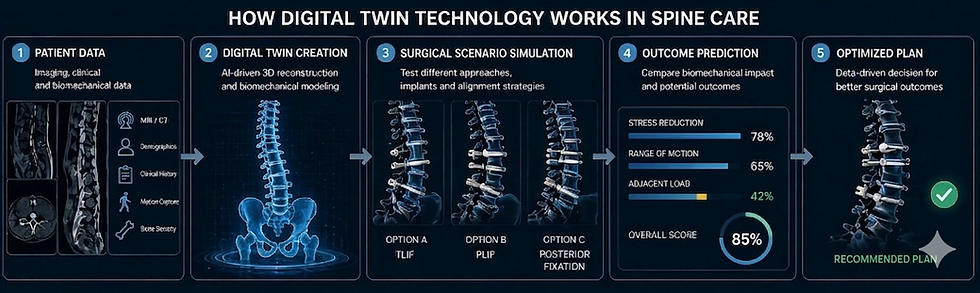
Digital twin models extend preoperative planning beyond anatomical interpretation by enabling simulation of spinal behavior under physiological conditions. Rather than relying solely on static imaging, clinicians can evaluate how a spine is likely to respond following intervention.
Emerging work has shown that these models can incorporate radiographic and biomechanical parameters to simulate deformity and quantify stress distribution across spinal segments, enabling a more precise understanding of mechanical consequences (3).
Digital twin workflow illustrating the progression from patient imaging to biomechanical simulation and preoperative decision support is shown here.
Evaluating Surgical Strategies Preoperatively
The clinical value of digital twin technology becomes particularly relevant in complex spine cases, where variability in outcomes remains a persistent challenge. These models allow for the evaluation of multiple surgical strategies within the same patient-specific framework.
By simulating different approaches such as decompression alone versus combined stabilization, or variations in implant configuration clinicians can assess how each option influences spinal mechanics prior to intervention.
Recent evidence suggests that these models can predict changes in intradiscal pressure, facet joint loading, and overall spinal stability, providing a more objective basis for surgical planning (3,4). This ability to compare intervention strategies in a controlled, virtual environment supports more informed and consistent decision-making.
Anticipating Biomechanical Consequences
A key consideration in spine surgery is how intervention alters load distribution across adjacent segments and within instrumentation constructs factors that are not fully captured through conventional preoperative assessment. Digital twin simulations enable evaluation of stress transfer across implants and endplates, as well as segmental loading under physiological conditions. This provides a more detailed understanding of construct behavior and adjacent level mechanics, supporting more informed planning in cases where biomechanical balance is critical. Early evidence suggests that integrating such insights into preoperative workflows may improve consistency in surgical strategy and reduce variability in outcomes.
Clinical Integration and Future Direction
Despite its potential, digital twin technology remains in an early stage of clinical adoption. Challenges related to model validation, data quality, and integration into existing workflows continue to shape its implementation. Establishing strong correlation between simulated predictions and real-world outcomes will be critical as these systems move closer to routine clinical use.
The direction, however, is clear. Digital twin technology introduces a more predictive, model-informed approach to spine care one that complements surgical expertise with patient-specific simulation. As validation efforts advance and workflows mature, these models are positioned to become a practical extension of preoperative planning, enabling a more consistent, data-driven, and individualized approach to spine surgery.
Stay updated with the latest advancements in spine innovation with LESS Society.
References:
Landinez D, Rodríguez CF, Cifuentes De la Portilla C. Patient-specific spine digital twins: a computational characterization of idiopathic scoliosis. J Orthop Surg Res. 2025;20:39. doi:10.1186/s13018-024-05417-0.
Menon G, Malave B, Mhaske M, Parjane S, Mhaismale H. Digital twin technologies in medicine: the innovations, barriers, and future directions. Intell Hosp. 2026;2(1):100043. doi:10.1016/j.inhs.2025.100043.
Li J, An Z, Wu J, Gao Y, Lu S, He D, et al. Construction of the adjusted scoliosis 3D finite element model and biomechanical analysis under gravity. Orthop Surg. 2023;15:606–16. doi:10.1111/os.13572.
Diniz P, Grimm B, Garcia F, Fayad J, Ley C, Mouton C, et al. Digital twin systems for musculoskeletal applications: a current concepts review. Knee Surg Sports Traumatol Arthrosc. 2025;33:1892–910. doi:10.1002/ksa.12627.


Comments