
Single-Use Instrumentation in Spine Surgery: Efficiency, Cost, and Accessibility
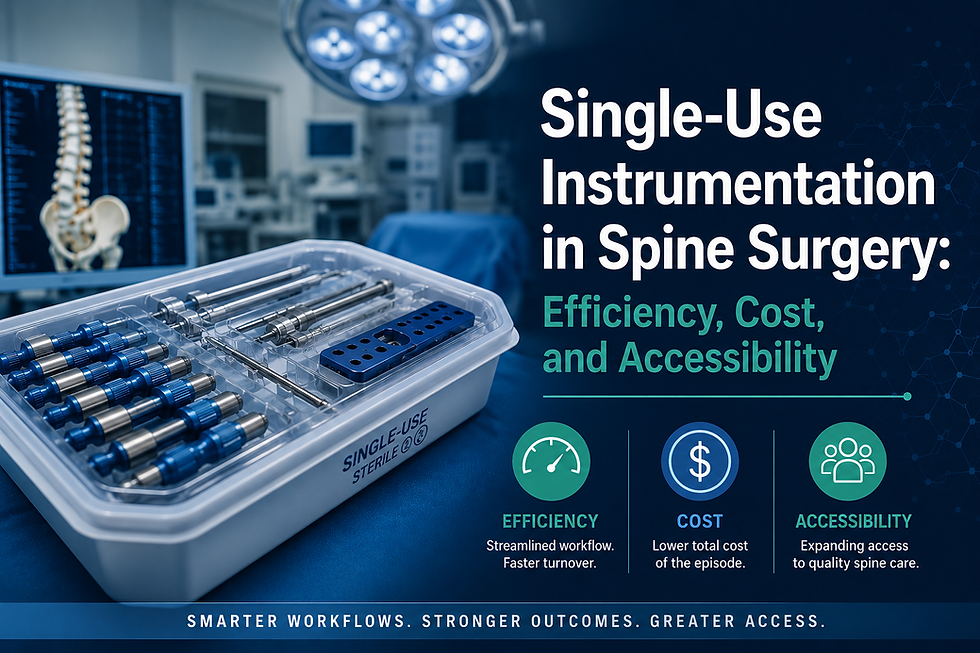
As spine surgery continues its shift toward ambulatory surgery centers (ASCs), one of the most interesting innovations isn't a robot, navigation system, or new implant; it may be the instrument's tray itself.
Single-use instrumentation (SUI), once considered a specialized solution, is attracting renewed attention as healthcare systems look for ways to improve efficiency, control costs, and expand access to surgical care. The growing interest may be driven less by the instruments themselves and more by the changing environments in which spine surgery is being performed. The continued growth of ASCs has renewed interest in technologies that support workflow efficiency, rapid turnover, and operational scalability (1, 2).
Efficiency: Meeting the Demands of Outpatient Spine Surgery
The migration of spine procedures into ASCs has placed a new emphasis on workflow efficiency and resource optimization.
Traditional reusable instrumentation requires transportation, sterilization, assembly, inspection, storage, and maintenance before every procedure. While these systems provide flexibility, they also depend heavily on personnel, sterile processing capacity, and inventory management.
Single-use systems simplify this process by arriving sterile and procedure-ready. A hospital micro-costing analysis of lumbar fusion procedures demonstrated significantly reduced instrument handling and processing requirements with single-use systems compared with reusable instrumentation.
For facilities managing increasing procedural volumes, reducing operational complexity can help improve efficiency and support consistent workflow without requiring additional resources.
Cost: Looking Beyond the Purchase Price
One of the most common criticisms of single-use instrumentation is cost.
At first glance, disposable instruments often appear more expensive than reusable alternatives. However, purchase price represents only a fraction of the total cost associated with instrumentation.
Reusable systems require ongoing investments in:
Sterile processing
Equipment maintenance and replacement
Inventory management
Storage and transportation
Quality assurance activities
As a result, healthcare systems are increasingly evaluating the total cost of a surgical episode rather than focusing solely on instrument acquisition costs. Value-based analyses suggest that economic decisions surrounding spinal instrumentation should account for the entire procedural pathway rather than isolated device costs.
The question is shifting from:
"What does the instrument cost?"
to
"What does the entire workflow cost?"
Accessibility: An Underappreciated Advantage
While efficiency and cost often dominate the discussion, accessibility may ultimately be one of the most important benefits of SUI technology.
Large hospitals typically have dedicated sterile processing departments and extensive instrument inventories. Smaller hospitals, rural facilities, emerging ASC programs, and healthcare systems in resource-limited settings may not have access to the same infrastructure.
By reducing dependence on extensive reprocessing and storage capabilities, single-use instrumentation may help support procedural consistency in environments where maintaining large reusable inventories is challenging.
As healthcare systems worldwide continue searching for ways to expand access to surgical care, this advantage is attracting increasing attention.
What About Infection Risk?
Infection prevention remains in another area of interest.
A prospective bi-centric study evaluating posterior lumbar fusion reported a reduction in surgical site infection rates from 6% to 2% following implementation of single-use instrumentation (2). While additional long-term studies are needed, the findings highlight the potential impact of eliminating reprocessing-related variables from the surgical pathway.
Given the significant clinical and economic burden associated with spinal surgical site infections, even modest reductions may have meaningful implications for patient outcomes, hospital resources, and healthcare utilization. Recent analyses continue to highlight the substantial costs, readmissions, and resource demands associated with SSI following spinal fusion procedures (3)

The Reality: Not an All-or-Nothing Decision
Despite their advantages, single-use systems are not without challenges.
Surgeons must remain confident that procedure-specific instrumentation provides sufficient flexibility for unexpected intraoperative findings. Many institutions continue to maintain access to conventional instrumentation or backup trays when needed.
As a result, many healthcare systems are exploring hybrid approaches that combine the efficiency of single-use technologies with the versatility of traditional reusable instrumentation (4).
Looking Ahead
The growing interest in single-use instrumentation reflects a broader trend in spine surgery: improving care not only through new implants and technologies, but also through smarter workflow design (5).
Industry observers suggest that increasing ASC utilization, staffing pressures, and the need for operational efficiency will continue to drive interest in procedure-specific instrumentation systems and streamlined surgical workflows.
As outpatient spine surgery continues to expand, the conversation is becoming less about disposable instruments and more about efficiency, scalability, and access.
Innovation in spine surgery takes many forms from advances in implants and robotics to improvements in the systems and workflows that support patient care.
Sometimes the greatest impact comes from rethinking the processes that make high-quality surgery more efficient, scalable, and accessible.
References
1. Bouthors C, Nguyen J, Durand L, Dubory A, Raspaud S, Court C. Single-use versus reusable medical devices in spinal fusion surgery: a hospital micro-costing analysis. Eur J Orthop Surg Traumatol. 2019;29(8):1631–7.
2. Litrico S, Recanati G, Gennari A, Maillot C, Saffarini M, Le Huec JC. Single-use instrumentation in posterior lumbar fusion could decrease incidence of surgical site infection: a prospective bi-centric study. Eur J Orthop Surg Traumatol. 2016;26(1):21–6.
3. Edmiston CE, Jr., Leaper DJ, Chitnis AS, Holy CE, Chen BP. Risk and economic burden of surgical site infection following spinal fusion in adults. Infect Control Hosp Epidemiol. 2023;44(1):88–95.
4. SPINEMarketGroup. Single-Use Spine Surgery Systems: The Future or Still a Niche? Leading Platforms in 2026 2026 [Available from: https://thespinemarketgroup.com/are-single-use-systems-the-inevitable-future-of-spinal-surgery-or-merely-a-niche-solution-what-are-the-leading-systems-on-the-market/.
5. Magazine AOS. The Case for Single-Use Spine Instruments 2025 [Available from: https://www.aorn.org/outpatient-surgery/article/the-case-for-single-use-spine-instruments.


Comments