
Understanding Spine Problems: A Simple Guide for Patients
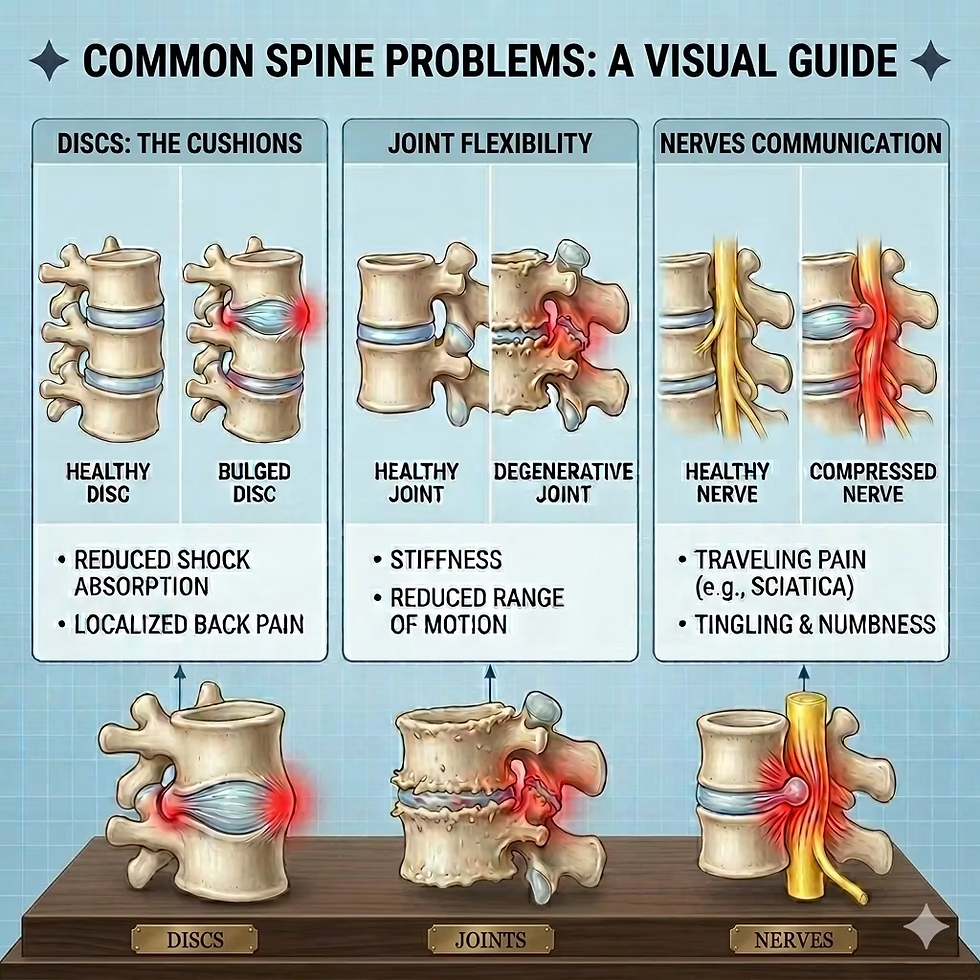
Disc bulge, spondylosis, and nerve compression are some of the common terms seen in medical reports for back or neck pain. Knowing what they refer to helps connect them to symptoms.
In the previous blog, we explored how the spine is structured. Building on that, the next step is to understand how changes in these structures can lead to different spine problems and symptoms.
To simplify how spine health works, it is helpful to view the back as an interconnected system of three core components: the discs that provide cushioning, the joints that allow for movement, and the nerves that transmit sensation throughout the body (1).
Most spine problems involve one or more of these structures. Problems affecting cushioning structures can influence movement; changes in the joints can lead to stiffness or localized pain, and when nerves are involved, symptoms may travel into the arms or legs.
How Spine Problems Cause Symptoms
Over time, the discs in the spine can gradually lose water content and height. This reduces their ability to absorb shock and changes how pressure is distributed. As a result, the joints at the back of the spine may take on more load, and surrounding tissues may become less flexible (2,3).

The spine works as a connected system, but symptoms can vary depending on which part such as the discs, joints, or nerves is more affected. Some changes may lead to localized discomfort or stiffness, while others may cause pain that travels, for example, into the arm or leg sometimes with tingling, numbness, or weakness.
This is why spine-related symptoms can feel different from person to person and may change over time.
Common Spine Problems You May Hear About
Some of the commonly described spine conditions include (4):
Disc herniation
Disc bulge
Sciatica
Spinal stenosis
Degenerative disc changes
Degenerative spondylosis
Pinched nerve (radiculopathy)
Facet joint pain
Sacroiliac (SI) joint dysfunction
Spondylolisthesis
Muscle strain or ligament injury
Cervical radiculopathy
Lumbar radiculopathy
Each of these terms highlights a specific type of change in the spine.
How Spine Problems Are Diagnosed and Managed
To understand the cause of symptoms, doctors consider both clinical findings and imaging. This includes evaluating how symptoms started, how they change with activity, and how the spine moves during examination. Nerve function may also be assessed if symptoms extend into the arms or legs.
When needed, imaging tests such as X-rays or MRI scans are used to identify structural changes in the spine. These findings are then correlated with symptoms to arrive at a diagnosis.
Treatment depends on the type and severity of the problem. In many cases, spine conditions can be managed with physical therapy, medications, and activity or posture adjustments. If symptoms persist or significantly affect daily function, other options such as targeted procedures or surgery may be considered (5).
Why This Matters and What’s Next
Understanding these terms helps make it easier to relate medical explanations to actual symptoms and recognize which part of the spine may be involved. In the next set of blogs, each symptom will be explained in detail, helping to better understand what it may indicate.
To learn more about spine-related conditions, treatments, and patient education resources, explore content from the LESS Society.
Frequently Asked Questions
1. Are these spine terms describing different problems or the same issue?
Many spine terms describe changes in different parts of the spine. They may sound separate, but they often explain how specific structures are affected rather than completely different conditions.
2. Why do spine symptoms sometimes change or move?
Spine symptoms can change depending on which part is involved. Problems affecting nerves may cause pain that travels into the arms or legs, while others may remain localized.
3. Do all spine problems require surgery?
No. Most spine conditions can be managed without surgery using physical therapy, medications, and lifestyle changes. Surgery is usually considered only when symptoms persist or significantly affect daily life.
References
Inoue N, Orías AAE, Segami K. Biomechanics of the Lumbar Facet Joint. Spine Surg Relat Res 2020;4:1–7. https://doi.org/10.22603/ssrr.2019-0017.
Izzo R, Popolizio T, D’Aprile P, Muto M. Spinal pain. Eur J Radiol 2015;84:746–56. https://doi.org/10.1016/j.ejrad.2015.01.018.
Raciborski F, Gasik R, Kłak A. Disorders of the spine. A major health and social problem. Reumatologia 2016;54:196–200. https://doi.org/10.5114/reum.2016.62474.
Alshami AM. Prevalence of spinal disorders and their relationships with age and gender. Saudi Med J 2015;36:725–30. https://doi.org/10.15537/smj.2015.6.11095.
Katz JN, Zimmerman ZE, Mass H, Makhni MC. Diagnosis and Management of Lumbar Spinal Stenosis: A Review. JAMA 2022;327:1688–99. https://doi.org/10.1001/jama.2022.5921.

Comments